Octordle
Introduction to Octordle
Octordle is one of those rare puzzle games that takes a simple idea and turns it into something both thrilling and mentally demanding. If you’ve ever played word games like Wordle and thought, “This is fun, but I want something more challenging,” then Octordle is exactly what you’ve been waiting for. Instead of guessing a single five-letter word, Octordle pushes your brain to juggle eight words simultaneously, all within a limited number of guesses. It’s not just a game—it’s a full-on mental workout.
What makes Octordle particularly fascinating is how it blends logic, vocabulary, and strategy. You’re not just solving one puzzle at a time; you’re solving eight interconnected puzzles, where each guess affects all boards at once. That means every decision you make carries more weight, and every mistake can ripple across multiple grids. It’s this layered complexity that keeps players coming back for more.
In recent years, word puzzle games have seen a massive surge in popularity, especially among people who enjoy casual gaming with a cognitive twist. Octordle stands out in this crowded space by offering something deeper and more intense. Whether you’re a seasoned word game enthusiast or someone just looking to challenge your brain in a new way, Octordle offers a unique experience that is both rewarding and addictive.
The Origins and Evolution of Octordle
Octordle didn’t appear out of nowhere. It’s part of a broader evolution of word puzzle games that gained momentum with the rise of simple, browser-based daily challenges. The concept builds on earlier formats, especially the idea of guessing words with limited attempts, but expands it in a way that dramatically increases complexity.
The success of earlier word games created a wave of innovation, where developers began experimenting with variations. Some increased the word length, others introduced time limits, and some—like Octordle—multiplied the number of puzzles. This approach tapped into a niche audience that craved more difficulty and a stronger sense of accomplishment.
What’s interesting about Octordle’s rise is how quickly it gained traction within online communities. Players began sharing their results, strategies, and experiences, turning the game into a social phenomenon. It became more than just a solo activity; it became something people discussed, compared, and even competed in. This sense of community has played a huge role in its ongoing popularity.
How Octordle Works
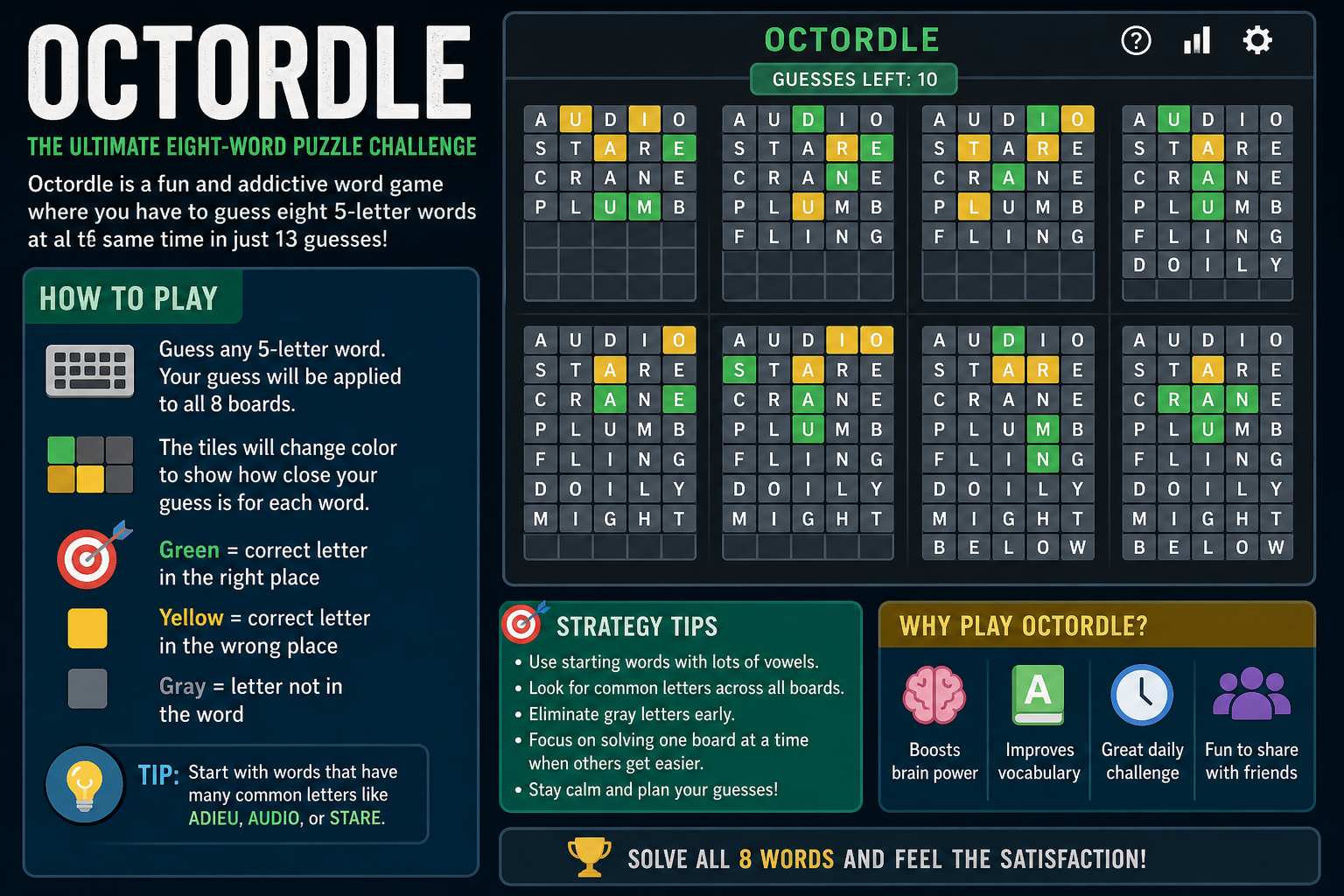
At its core, Octordle follows a simple rule: guess eight five-letter words in a limited number of attempts. But the execution is anything but simple. You’re given multiple grids—eight, to be exact—and each guess you enter applies to all of them simultaneously. This means a single word can reveal clues across multiple puzzles.
Each grid provides feedback in the form of colored tiles. Typically, a correct letter in the correct position is highlighted in green, a correct letter in the wrong position appears in yellow, and incorrect letters remain unmarked. This system helps you narrow down possibilities, but managing eight sets of feedback at once can quickly become overwhelming.
The real challenge lies in balancing your guesses. You need to choose words that maximize information across all grids while also progressing toward solving individual puzzles. This requires a mix of intuition, planning, and adaptability. It’s not just about knowing words—it’s about knowing how to use them effectively.
Why Octordle Is So Addictive
There’s something uniquely satisfying about solving an Octordle puzzle. It’s not just the act of finding the correct words; it’s the journey of piecing together clues, making educated guesses, and watching multiple puzzles come together simultaneously. This layered reward system keeps players engaged for longer periods.
One reason for its addictive nature is the balance between difficulty and fairness. Octordle is challenging, but it rarely feels impossible. Even when you fail, you often feel like you were close, which motivates you to try again. That sense of “almost there” is a powerful driver in game design.
Another factor is the daily challenge aspect. Many players make Octordle part of their routine, similar to solving a crossword or Sudoku. This consistency builds a habit, and over time, players develop their own strategies and styles. The game becomes not just a pastime, but a personal challenge to improve and refine one’s skills.
Strategies for Beginners
If you’re new to Octordle, it’s easy to feel overwhelmed at first. Eight grids, multiple guesses, and a flood of information can be a lot to process. The key is to start with a structured approach. Begin by choosing strong opening words that include common vowels and consonants. This helps you gather as much information as possible early on.
Another useful strategy is to focus on eliminating possibilities. Instead of trying to solve one grid at a time, aim to gather clues across all boards. This might mean using guesses that aren’t immediately obvious solutions but provide valuable insights. Think of it as laying the groundwork for future moves.
Patience is also crucial. Octordle is not a game you can rush through. Take your time to analyze the feedback from each guess and consider how it applies to all grids. Over time, you’ll develop a rhythm and start recognizing patterns more quickly. Like any skill, it improves with practice.
Advanced Techniques for Experienced Players
Once you’re comfortable with the basics, you can start exploring more advanced strategies. One key technique is prioritization. As the game progresses, some grids will become easier to solve than others. Focus on completing those first, as it reduces the overall complexity and helps you concentrate on the remaining puzzles.
Another advanced approach is strategic guessing. Instead of always aiming to solve a word, sometimes it’s better to use a guess purely for information gathering. This can be especially useful when you’re stuck between multiple possibilities. A well-chosen guess can clarify several grids at once.
Experienced players also pay close attention to letter frequency and patterns. Understanding which letters are more likely to appear can help you make smarter guesses. Additionally, recognizing common word structures—like prefixes and suffixes—can give you an edge when narrowing down options.
Common Mistakes to Avoid
Even seasoned players can fall into certain traps when playing Octordle. One of the most common mistakes is focusing too much on a single grid. While it might be tempting to solve one puzzle completely, doing so can limit your ability to gather information for the others.
Another mistake is ignoring feedback. Every guess provides valuable clues, and overlooking even a small detail can lead to incorrect assumptions. Make sure you’re carefully analyzing each grid after every guess and adjusting your strategy accordingly.
Overconfidence can also be an issue. Just because a word seems like a likely solution doesn’t mean it’s correct. Always double-check your reasoning and consider alternative possibilities. Staying flexible and open-minded is key to success in Octordle.
The Cognitive Benefits of Playing Octordle
Beyond entertainment, Octordle offers several cognitive benefits. It challenges your brain in ways that few other games do, requiring you to think critically, analyze patterns, and make decisions under pressure. This kind of mental exercise can help improve problem-solving skills and enhance memory.
Playing Octordle regularly can also expand your vocabulary. As you encounter new words and experiment with different combinations, you naturally become more familiar with language. This can be particularly beneficial for students, writers, and anyone looking to improve their communication skills.
Additionally, the game promotes focus and concentration. Managing multiple grids at once requires sustained attention, which can help train your brain to stay engaged for longer periods. In a world full of distractions, this is a valuable skill to develop.
Octordle vs Other Word Games
Octordle stands out from other word games due to its scale and complexity. While many games focus on a single puzzle, Octordle multiplies the challenge, creating a more intense and immersive experience. This makes it particularly appealing to players who enjoy a higher level of difficulty.
Compared to simpler games, Octordle requires a more strategic approach. You can’t rely on trial and error alone; you need to think several steps ahead and consider the impact of each guess. This added depth is what sets it apart and keeps players engaged.
However, it’s worth noting that Octordle may not be for everyone. Its complexity can be intimidating for beginners, and it requires a certain level of commitment. That said, for those who embrace the challenge, it offers a uniquely rewarding experience.
Tips to Improve Your Daily Performance
Improving at Octordle takes time, but there are several ways to accelerate your progress. One effective method is to review your past games. Analyze where you went wrong and identify patterns in your mistakes. This can help you avoid similar errors in the future.
Another tip is to expand your vocabulary. The more words you know, the more options you have when making guesses. Reading, writing, and even playing other word games can contribute to this growth.
Consistency is also important. Playing regularly helps you develop a better understanding of the game’s mechanics and improves your ability to recognize patterns. Over time, you’ll find that what once seemed difficult becomes much more manageable.
The Social Side of Octordle
Octordle isn’t just a solo experience—it has a strong social component as well. Many players enjoy sharing their results with friends or on social media, comparing scores and discussing strategies. This adds an extra layer of engagement and makes the game more interactive.
Online communities have formed around Octordle, where players exchange tips, celebrate successes, and help each other improve. These communities can be a valuable resource, especially for beginners looking to learn from more experienced players.
The competitive aspect also adds to the fun. Whether you’re trying to beat your own record or outperform your friends, Octordle provides plenty of opportunities for friendly competition. This social dynamic is a big part of what makes the game so appealing.
The Future of Octordle
As word puzzle games continue to evolve, Octordle is likely to remain a key player in the genre. Its unique approach and dedicated player base give it a strong foundation for continued growth. Developers may introduce new features, variations, or challenges to keep the game fresh and engaging.
There’s also potential for expansion into different platforms. While Octordle is primarily browser-based, it could easily be adapted into mobile apps or integrated with other gaming ecosystems. This would make it even more accessible to a wider audience.
Ultimately, the future of Octordle depends on its community. As long as players continue to engage with the game, share their experiences, and push its boundaries, it will remain a vibrant and exciting part of the word puzzle landscape.
Conclusion
Octordle is more than just a game—it’s a test of skill, strategy, and mental agility. By challenging players to solve eight puzzles at once, it offers a unique experience that stands out in the world of word games. Whether you’re a beginner or an experienced player, there’s always something new to learn and improve.
Its combination of complexity, reward, and community engagement makes it a truly compelling experience. While it may seem daunting at first, those who stick with it will find themselves developing new skills and enjoying the satisfaction of mastering a challenging puzzle.
If you’re looking for a game that pushes your limits and keeps your mind sharp, Octordle is definitely worth your time. Dive in, embrace the challenge, and see how far your word-solving abilities can take you.
YOU MAY HAVE MISSED
About the Author