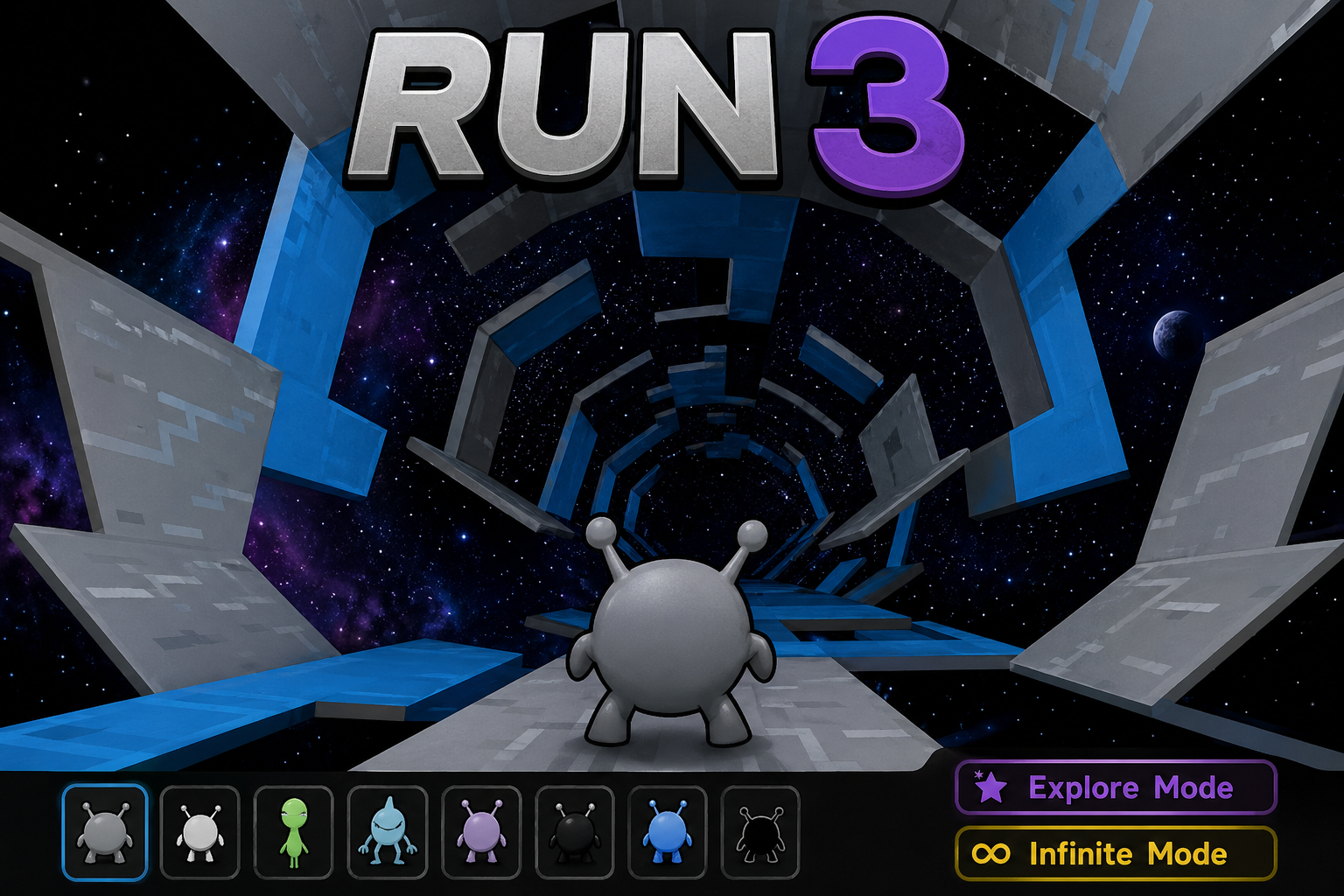
Run 3
Introduction to Run 3
Run 3 is one of those rare browser games that manages to feel both simple and endlessly deep at the same time. At first glance, it looks like a straightforward endless runner: a small alien character sprinting through a tunnel in space. But once you spend a little time with it, you realize there’s far more going on beneath the surface. It blends reflex-based gameplay with puzzle-like level design, creating an experience that’s surprisingly engaging.
The game belongs to the long-running Run series, which gained popularity for its minimalistic design and addictive mechanics. However, Run 3 stands out as the most refined and expansive version. It takes everything that worked in earlier entries and builds on it with new characters, branching paths, and a narrative structure that unfolds gradually as you progress.
What truly makes Run 3 memorable is how it evolves alongside the player. Early levels ease you in gently, but before long, you’re dealing with complex spatial challenges, gravity shifts, and precision timing. It doesn’t overwhelm you immediately—instead, it teaches you by doing, making every success feel earned.
The Core Gameplay Mechanics
At its heart, Run 3 revolves around running, jumping, and surviving. You control a character moving through a series of tunnels suspended in space. The goal is simple: don’t fall. But achieving that goal becomes increasingly complex as the game introduces broken pathways, rotating surfaces, and gaps that demand perfect timing.
One of the defining mechanics is the ability to rotate the tunnel. Instead of just running forward, you can shift gravity by moving left or right, effectively turning walls into floors. This adds a unique dimension to the gameplay, transforming what could have been a standard runner into something far more strategic.
The controls are intentionally simple, which is part of the game’s charm. Anyone can pick it up within seconds. Yet mastering it takes time. The challenge doesn’t come from complicated inputs but from understanding the environment and reacting quickly. This balance between accessibility and depth is a big reason why the game has remained popular for so long.
Game Modes: Infinite vs Explore
Run 3 offers two primary modes, each catering to a different style of play. The Infinite Mode is exactly what it sounds like—an endless run where the difficulty gradually increases. It’s perfect for players who enjoy chasing high scores and testing their reflexes over long sessions.
Explore Mode, on the other hand, is where the game truly shines. Instead of a continuous run, you progress through a map of interconnected levels. Each level introduces new challenges, and you can choose different paths depending on your progress. This mode feels almost like a puzzle-platformer rather than a traditional runner.
What makes Explore Mode especially compelling is its sense of progression. You’re not just running aimlessly; you’re uncovering new areas, unlocking characters, and slowly piecing together the game’s world. It adds a layer of purpose that keeps players invested beyond simple score-chasing.
Characters and Their Unique Abilities
One of the standout features of Run 3 is its diverse cast of characters. Each character has unique abilities that change how you approach the game. For example, some characters can jump higher, while others have better control or can survive longer on unstable tiles.
This variety encourages experimentation. A level that feels impossible with one character might become manageable with another. It adds a strategic layer to the game, as you need to think about which character is best suited for a particular challenge.
The characters also contribute to the game’s subtle storytelling. Each one has its own personality and role within the game’s universe. While the narrative isn’t presented in a traditional way, it emerges through dialogue snippets and interactions, giving the game a surprising amount of depth.
Level Design and Increasing Complexity
The level design in Run 3 is where the game truly excels. Early stages are straightforward, helping players get comfortable with the mechanics. But as you progress, the levels become more intricate, introducing new obstacles and requiring more precise movements.
You’ll encounter disappearing tiles, narrow pathways, and sections where the only way forward is to rotate the tunnel strategically. These elements force you to think ahead rather than just react. It’s not just about speed—it’s about planning your moves.
What’s impressive is how the game maintains a sense of fairness. Even when a level feels difficult, it rarely feels impossible. Each failure teaches you something, and with enough practice, you can overcome even the toughest challenges. This balance keeps players motivated rather than frustrated.
The Role of Gravity and Perspective
Gravity manipulation is the defining mechanic that sets Run 3 apart from other endless runners. By shifting the direction of gravity, you can run on walls and ceilings, effectively changing the layout of the level in real time.
This mechanic adds a puzzle-like element to the game. You’re not just reacting to obstacles—you’re actively shaping your path through the level. It requires spatial awareness and quick decision-making, especially in later stages where the margin for error is minimal.
The shifting perspective also keeps the gameplay visually interesting. Even though the graphics are relatively simple, the constant movement and rotation create a dynamic experience that feels fresh even after hours of play.
Visual Style and Sound Design
Run 3 doesn’t rely on flashy graphics to make an impression. Instead, it embraces a minimalist aesthetic. The tunnels are clean and geometric, and the characters are simple yet expressive. This simplicity works in the game’s favor, ensuring that the focus remains on gameplay.
The space-themed environment adds to the sense of isolation and challenge. You’re essentially navigating a series of floating pathways in a vast void, which creates a unique atmosphere. It’s both calming and slightly tense at the same time.
The sound design complements this perfectly. The background music is subtle and ambient, enhancing the experience without being distracting. Sound effects are minimal but effective, providing feedback that helps you stay focused on the game.
Why Run 3 Became So Popular
Run 3 gained widespread popularity for several reasons. First, it’s incredibly accessible. Being a browser-based game means you can play it almost anywhere without needing to download anything. This made it a favorite among students and casual gamers.
Second, the gameplay is addictive. The combination of simple controls and challenging levels creates a loop that’s hard to break. You always feel like you’re one attempt away from success, which keeps you coming back.
Finally, the game’s depth sets it apart. It’s not just a quick distraction—it’s something you can invest time in. Whether you’re trying to unlock all characters or complete every level, there’s always something to work toward.
Tips and Strategies for Mastering Run 3
If you want to improve at Run 3, the first step is to stay calm. Panic is your biggest enemy, especially in fast-paced sections. Focus on your movements and try to anticipate obstacles rather than reacting at the last second.
Another important tip is to use gravity shifts wisely. Don’t just rotate the tunnel randomly—plan your moves ahead of time. Look for safe paths and think about how each rotation will affect your trajectory.
Finally, practice with different characters. Each one offers a unique advantage, and finding the right fit for your playstyle can make a big difference. Experimentation is key to mastering the game.
The Evolution of the Run Series
Run 3 didn’t appear out of nowhere—it’s the result of gradual evolution. The earlier games in the series laid the foundation with basic mechanics and level design. Each installment introduced new ideas, leading up to the more complex and polished experience of Run 3.
This progression is evident in every aspect of the game. From the expanded character roster to the more intricate level design, Run 3 feels like a culmination of everything that came before it. It’s a great example of how a simple concept can grow into something much more sophisticated over time.
The developers clearly understood what made the original games fun and built on those strengths. Instead of reinventing the wheel, they refined it, resulting in a game that feels both familiar and fresh.
Educational and Cognitive Benefits
While Run 3 is primarily a game, it also offers some cognitive benefits. The need for quick decision-making and spatial awareness can help improve reaction time and problem-solving skills.
The gravity-shifting mechanic, in particular, encourages players to think in three dimensions. It’s not just about moving forward—you have to consider multiple perspectives and plan your actions accordingly. This kind of thinking can be surprisingly beneficial in real-world scenarios.
Additionally, the game promotes persistence. Many levels require multiple attempts to complete, teaching players the value of practice and patience. It’s a subtle but meaningful lesson that extends beyond the game itself.
Challenges and Limitations
Despite its many strengths, Run 3 isn’t without its challenges. Some players may find the difficulty curve a bit steep, especially in later levels. While the game is generally fair, it can occasionally feel unforgiving.
Another limitation is the lack of variety in visuals. While the minimalist design works well, it can start to feel repetitive after extended play sessions. A bit more visual diversity could have enhanced the overall experience.
That said, these issues don’t significantly detract from the game’s appeal. They’re minor drawbacks in an otherwise well-crafted experience.
The Legacy of Run 3
Run 3 has left a lasting impact on the world of browser gaming. It proved that simple games can still be deep and engaging, inspiring other developers to explore similar ideas.
Even years after its release, it continues to attract new players. Its timeless design and accessible gameplay ensure that it remains relevant in an ever-changing gaming landscape.
The game’s legacy is a testament to the power of good design. It doesn’t rely on cutting-edge technology or complex mechanics—just a solid idea executed exceptionally well.
Conclusion
Run 3 is more than just an endless runner—it’s a thoughtfully designed experience that combines simplicity with depth. Its unique mechanics, engaging level design, and subtle storytelling make it stand out in a crowded genre.
Whether you’re a casual player looking for a quick distraction or someone who enjoys mastering challenging games, Run 3 has something to offer. It’s easy to pick up but hard to put down, which is exactly what makes it so compelling.
In a world where games are becoming increasingly complex, Run 3 serves as a reminder that sometimes, less is more. And when done right, even the simplest ideas can lead to something truly memorable.
YOU MAY HAVE MISSED
About the Author