Search Operat
Introduction to Search Operators
Search operators are one of those underrated tools that quietly transform how you interact with the internet. Most people type a few words into a search engine and hope for the best, but professionals—from digital marketers to researchers—approach search differently. They use operators to narrow down results, eliminate noise, and find exactly what they’re looking for in seconds.
At their core, search operators are special commands or symbols you add to your search queries. These commands tell search engines like Google how to filter results. Instead of relying on algorithms to guess your intent, you guide the system with precision. That’s why search operators are often considered a “power user” feature.
If you’ve ever struggled to find a specific document, track down a competitor’s content, or locate a file buried deep on a website, search operators are your solution. They allow you to refine your queries in ways that standard keyword searches simply cannot.
Understanding search operators isn’t just about memorizing a few commands. It’s about developing a mindset—thinking critically about how information is structured online and how you can access it efficiently. Once you grasp that, your search skills improve dramatically.
Why Search Operators Matter More Than Ever
The internet has grown exponentially, and with that growth comes clutter. Millions of pages are created every day, making it harder to find relevant, high-quality information. This is where search operators become essential.
Without operators, you rely entirely on the search engine’s interpretation of your query. While modern search engines are incredibly smart, they’re not perfect. They may prioritize popular content over accurate content or show results that only loosely match your intent. Search operators give you control.
For professionals, this control translates into efficiency. Imagine being able to find specific PDFs, track mentions of a brand, or uncover hidden pages on a website within seconds. That’s the kind of advantage search operators provide.
Another reason they matter is competitive research. Businesses use search operators to analyze competitors, discover backlink opportunities, and identify content gaps. In a world driven by data, having the ability to extract precise information is a major advantage.
Ultimately, search operators are about working smarter, not harder. They reduce the time spent sifting through irrelevant results and help you focus on what truly matters.
Basic Search Operators Everyone Should Know
Before diving into advanced techniques, it’s important to understand the foundational search operators. These are simple yet powerful tools that can dramatically improve your search experience.
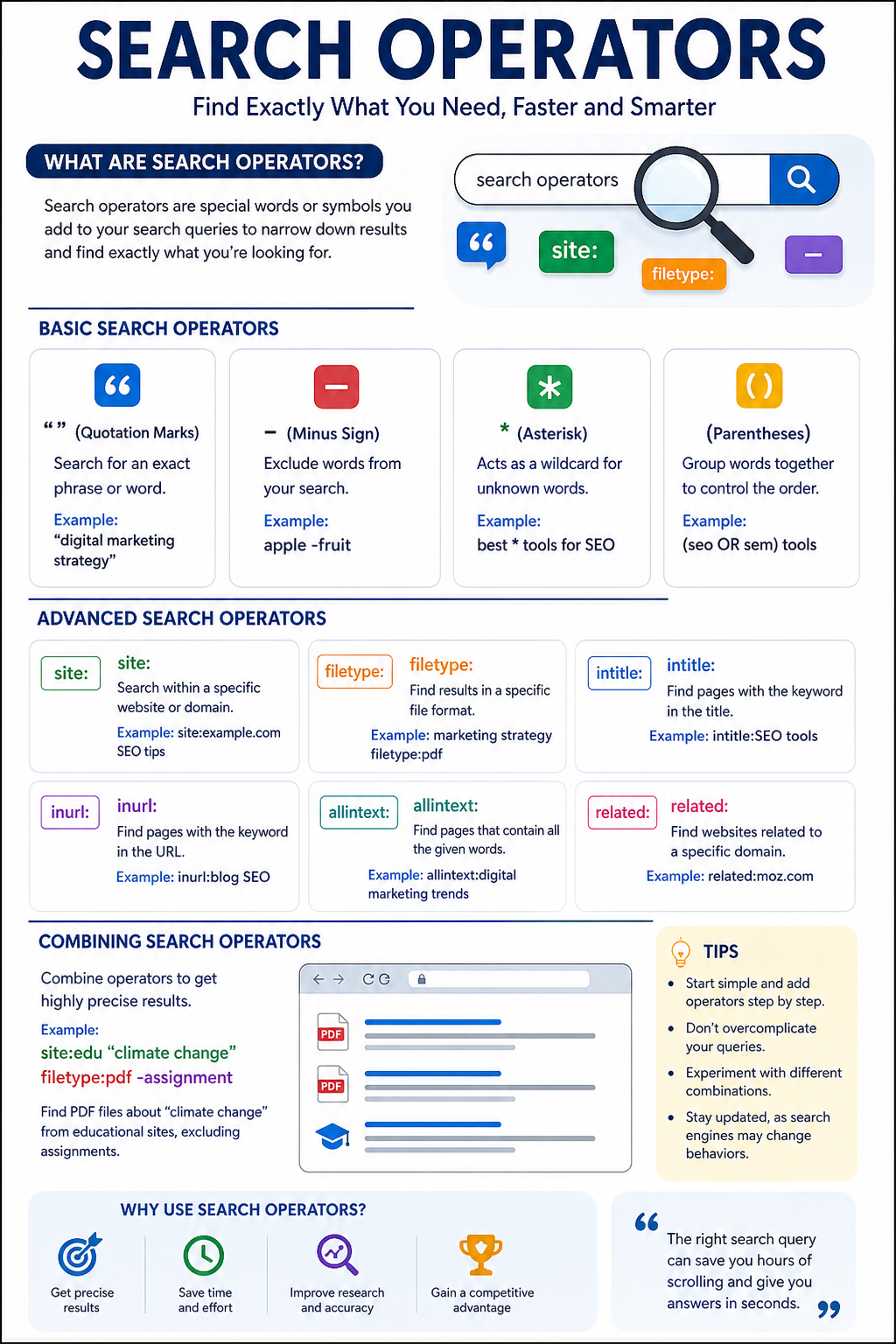
One of the most common operators is the quotation mark (” “). When you place a phrase inside quotes, the search engine looks for that exact phrase. This is incredibly useful when searching for specific sentences, quotes, or product names. Without quotes, the engine might rearrange or interpret your words differently.
Another essential operator is the minus sign (-). This allows you to exclude certain terms from your search. For example, if you’re searching for “apple” but don’t want results related to the fruit, you can type “apple -fruit.” This helps eliminate irrelevant content quickly.
The asterisk (*) acts as a wildcard. It replaces unknown words in a phrase. For instance, searching “best * tools for SEO” will return results with various words filling the gap, such as “best free tools for SEO” or “best online tools for SEO.”
These basic operators might seem simple, but they form the foundation of more advanced techniques. Mastering them is the first step toward becoming a more efficient searcher.
Advanced Search Operators for Precision
Once you’re comfortable with the basics, advanced search operators open up a whole new level of precision. These operators allow you to filter results based on domains, file types, and even specific sections of a webpage.
The “site:” operator is one of the most powerful tools available. It restricts your search to a specific website or domain. For example, “site:example.com SEO tips” will only show results from that website. This is particularly useful for navigating large websites or finding content within a trusted source.
Another valuable operator is “filetype:”. This lets you search for specific types of files, such as PDFs, Word documents, or spreadsheets. For instance, “marketing strategy filetype:pdf” will return downloadable documents related to marketing strategies.
The “intitle:” operator focuses on page titles. It ensures that your keyword appears in the title of the webpage, which often indicates higher relevance. Similarly, “inurl:” searches for keywords within the URL, helping you find pages with specific structures or topics.
These advanced operators are especially useful for researchers and professionals who need targeted information. They reduce guesswork and provide highly relevant results.
Combining Search Operators for Maximum Effect
The real power of search operators becomes evident when you combine them. Instead of using a single operator, you can layer multiple commands to create highly specific queries.
For example, you could search:
“site:edu ‘climate change’ filetype:pdf”
This query will return PDF documents about climate change from educational institutions. It’s a level of precision that standard searches simply can’t achieve.
Combining operators also allows you to refine your searches step by step. If your initial query returns too many results, you can add more operators to narrow it down. If it’s too restrictive, you can remove some elements.
Another example might be:
“intitle:SEO tools -free”
This will show pages with “SEO tools” in the title while excluding those that mention “free.” This is useful when you’re looking for premium or professional resources.
The key to combining operators effectively is experimentation. Try different combinations and observe how the results change. Over time, you’ll develop an intuitive understanding of how to craft precise queries.
Search Operators for SEO Professionals
Search operators are a cornerstone of search engine optimization (SEO). Professionals in this field rely on them for everything from keyword research to competitor analysis.
One common use is identifying indexed pages. By using the “site:” operator, SEO experts can see how many pages of a website are indexed by search engines. This helps identify issues like duplicate content or missing pages.
Another important application is backlink analysis. While dedicated tools exist for this purpose, search operators can provide quick insights. For example, searching for a brand name in quotes can reveal where it’s mentioned online.
SEO professionals also use operators to find guest posting opportunities. Queries like “write for us” combined with a niche keyword can uncover websites that accept contributions.
In addition, search operators help identify content gaps. By analyzing what competitors are ranking for, you can discover topics that haven’t been fully explored and create content to fill those gaps.
Using Search Operators for Academic Research
For students and researchers, search operators are invaluable. Academic research often requires precise, credible sources, and operators make it easier to find them.
The “site:edu” operator is particularly useful for accessing educational resources. Similarly, “site:gov” helps you find government publications, which are often reliable and data-driven.
Using quotation marks ensures that you find exact phrases, which is crucial when searching for specific theories or concepts. Meanwhile, the “filetype:” operator helps locate research papers, many of which are published as PDFs.
Another helpful technique is combining operators with date filters. This allows you to find the most recent studies on a topic, ensuring that your research is up to date.
By mastering these techniques, students can save hours of time and improve the quality of their work significantly.
Search Operators for Content Creators
Content creators can also benefit greatly from search operators. Whether you’re writing blog posts, creating videos, or managing social media, these tools can help you generate ideas and find inspiration.
One effective strategy is using operators to analyze trending content. By searching for specific keywords within titles, you can see what topics are gaining traction. This helps you create content that resonates with your audience.
Search operators are also useful for finding statistics and data. Queries like “digital marketing statistics filetype:pdf” can lead you to credible sources that enhance your content.
Another application is competitor research. By analyzing what other creators in your niche are publishing, you can identify gaps and opportunities. This allows you to create unique, valuable content that stands out.
In a competitive digital landscape, having access to precise information is a major advantage for content creators.
Common Mistakes to Avoid
While search operators are powerful, they’re not foolproof. Many users make mistakes that limit their effectiveness.
One common mistake is overcomplicating queries. Adding too many operators can restrict results too much, leaving you with little or no useful information. It’s important to strike a balance between specificity and flexibility.
Another mistake is using outdated operators. Search engines frequently update their algorithms, and some operators may no longer work as expected. Staying updated is crucial.
Users also often forget to experiment. Search operators are not a one-size-fits-all solution. What works for one query might not work for another. Trying different combinations is key to finding the best results.
Avoiding these mistakes will help you get the most out of search operators and improve your overall search experience.
The Future of Search Operators
As search engines continue to evolve, the role of search operators is also changing. Artificial intelligence and natural language processing are making search engines more intuitive, but operators still have a place.
In fact, they’re becoming more valuable for advanced users. While casual users rely on AI-driven suggestions, professionals need precise control over their searches. Search operators provide that control.
We can also expect new operators and features to emerge. As the internet grows, the need for efficient search tools will only increase. Search engines may introduce more advanced filtering options to meet this demand.
Despite these changes, the core concept of search operators remains the same: giving users the ability to refine and control their searches. This makes them a timeless tool in the digital world.
Final Thoughts
Search operators are more than just a technical feature—they’re a skill. Learning how to use them effectively can transform the way you interact with the internet.
From basic commands to advanced combinations, these tools offer unparalleled precision. Whether you’re a student, professional, or content creator, mastering search operators can save time, improve accuracy, and enhance productivity.
The key is practice. Start with simple operators, experiment with combinations, and gradually build your expertise. Over time, you’ll find that searching becomes faster, easier, and far more effective.
In a world overflowing with information, the ability to find exactly what you need is a powerful advantage. Search operators give you that advantage—if you know how to use them.
YOU MAY HAVE MISSED
About the Author